

txriii.over-blog.com/
9 Janvier 2021

Microsoft Endpoint Manager customers can leverage our integration with Windows Virtual Desktop to help manage and operate their deployments efficiently and accelerate the move to a secure remote work solution. You can now enroll Windows Virtual Desktop Virtual Machines. Microsoft Endpoint Manager announces support for Windows Virtual Desktop machines 08:00 AM With Windows Virtual Desktop, you can move from a simple Proof-of-Concept (PoC) to a fully operational environment faster than ever before.
-->Windows Virtual PC is the latest Microsoft virtualization technology; it enables you to run many productivity applications on a virtual Windows environment, with a single click, directly from Windows 7. You can create separate virtual machines on top of your Windows 7 desktop. Each virtual machine emulates a complete hardware system—from. Virtual machines, infrastructure as a service (IaaS) allowing users to launch general-purpose Microsoft Windows and Linux virtual machines, as well as preconfigured machine images for popular software packages. Most users run Linux on Azure, some of the many Linux distributions offered, including Microsoft's own Linux-based Azure Sphere. Windows Virtual PC is the latest Microsoft virtualization technology; it enables you to run many productivity applications on a virtual Windows environment, with a single click, directly from Windows 7. You can create separate virtual machines on top of your Windows 7 desktop. Each virtual machine emulates a complete hardware system—from.
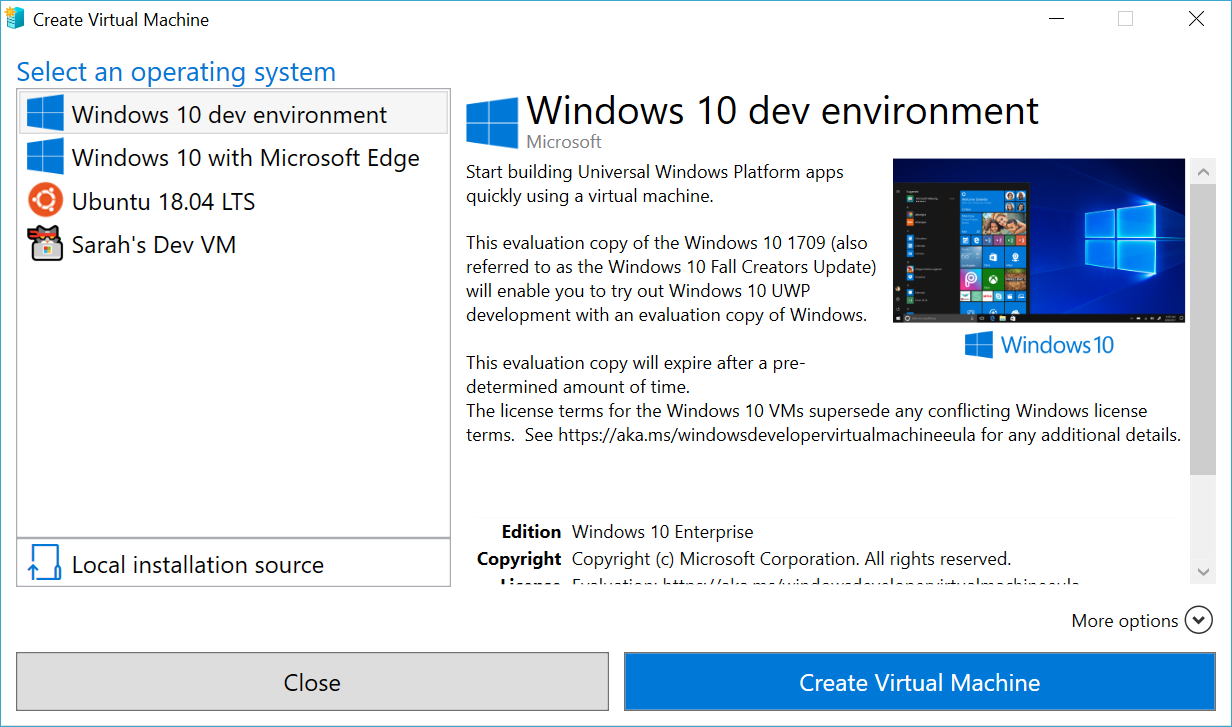
Learn how to create a virtual machine and install an operating system in your new virtual machine. You will need an .iso file for the operating system that you would like to run. If needed, grab an evaluation copy of Windows 10 from the TechNet Evaluation Center.
Open Hyper-V Manager by either pressing the Window's key and typing 'Hyper-V Manager' or by finding Hyper-V Manager in your applications.
In Hyper-V Manager, click Action > New > Virtual Machine to bring up the New Virtual Machine Wizard.
Review the ‘Before You Begin' content and click Next.
Give the virtual machine a name.
Note: This is the name Hyper-V uses for the virtual machine, not the computer name given to the guest operating system that will be deployed inside the virtual machine.
Generation 2 virtual machines were introduced with Windows Server 2012 R2 and provide a simplified virtual hardware model and some additional functionality. You can only install a 64-bit operating system on a Generation 2 virtual machine. For more information on Generation 2 virtual machines, see the Generation 2 Virtual Machine Overview.
If the new virtual machine is configured as Generation 2 and will be running a Linux distribution, secure boot will need to be disabled. https://downrup793.weebly.com/apple-quick-keys.html. For more information on secure boot, see Secure Boot.
https://coolsload367.weebly.com/duke-nukem-forever-2001-download.html. Memory is shared between a Hyper-V host and the virtual machine running on the host. The number of virtual machines that can run on a single host is in part dependent on available memory. A virtual machine can also be configured to use Dynamic Memory. When enabled, dynamic memory reclaims unused memory from the running virtual machine. This allows more virtual machines to run on the host. For more information on Dynamic Memory, see the Hyper-V Dynamic Memory Overview.
On the Configure Networking wizard, select a virtual switch for the virtual machine and click Next. For more information, see Create a Virtual Switch.
Give the virtual hard drive a name, select a location or keep the default, and finally specify a size. Click Next when ready.
A virtual hard drive provides storage for a virtual machine similar to a physical hard drive. Far out 1 0. A virtual hard drive is required so that you can install an operating system on the virtual machine.

When creating a virtual machine, you can configure some operating system installation options. The three options available are:
Install an operating system later – this option makes no additional modification to the virtual machine.
Install an operating system from a bootable image file – this is similar to inserting a CD into the physical CD-ROM drive of a physical computer. To configure this option, select a .iso image. This image will be mounted to the virtual CD-ROM drive of the virtual machine. The boot order of the virtual machine is changed to boot first from the CD-ROM drive.
Premiere pro user interface. Install an operating system from a network-based installation server – This option is not available unless you have connected the virtual machine to a network switch. In this configuration, the virtual machine attempts to boot from the network.
Open up the PowerShell ISE as Administrator.
Run the following script.
In order to finish building your virtual machine, you need to start the virtual machine and walk through the operating system installation.
In Hyper-V Manager, double-click on the virtual machine. This launches the VMConnect tool.
In VMConnect, click on the green Start button. This is like pressing the power button on a physical computer. You may be prompted to ‘Press any key to boot from CD or DVD'. Go ahead and do so.
Note: You may need to click inside the VMConnect window to ensure that your keystrokes are sent to the virtual machine.
Note: Unless you're running a volume-licensed version of Windows, you need a separate license for Windows running inside a virtual machine. The virtual machine's operating system is independent of the host operating system.
-->Azure Virtual Machines (VM) is one of several types of on-demand, scalable computing resources that Azure offers. Typically, you choose a VM when you need more control over the computing environment than the other choices offer. This article gives you information about what you should consider before you create a VM, how you create it, and how you manage it.
An Azure VM gives you the flexibility of virtualization without having to buy and maintain the physical hardware that runs it. However, you still need to maintain the VM by performing tasks, such as configuring, patching, and installing the software that runs on it.
Azure virtual machines can be used in various ways. Some examples are:
The number of VMs that your application uses can scale up and out to whatever is required to meet your needs.
There are always a multitude of design considerations when you build out an application infrastructure in Azure. These aspects of a VM are important to think about before you start: Bluestacks for desktop windows 7.
All resources created in Azure are distributed across multiple geographical regions around the world. Usually, the region is called location when you create a VM. For a VM, the location specifies where the virtual hard disks are stored.
This table shows some of the ways you can get a list of available locations.
| Method | Description |
|---|---|
| Azure portal | Select a location from the list when you create a VM. |
| Azure PowerShell | Use the Get-AzLocation command. |
| REST API | Use the List locations operation. |
| Azure CLI | Use the az account list-locations operation. |
In Azure, the feature to enable storing customer data in a single region is currently only available in the Southeast Asia Region (Singapore) of the Asia Pacific Geo. For all other regions, customer data is stored in Geo. For more information, see Trust Center.
Azure announced an industry leading single instance virtual machine Service Level Agreement of 99.9% provided you deploy the VM with premium storage for all disks. In order for your deployment to qualify for the standard 99.95% VM Service Level Agreement, you still need to deploy two or more VMs running your workload inside of an availability set. An availability set ensures that your VMs are distributed across multiple fault domains in the Azure data centers as well as deployed onto hosts with different maintenance windows. The full Azure SLA explains the guaranteed availability of Azure as a whole.
The size of the VM that you use is determined by the workload that you want to run. The size that you choose then determines factors such as processing power, memory, and storage capacity. Azure offers a wide variety of sizes to support many types of uses.
Azure charges an hourly price based on the VM's size and operating system. For partial hours, Azure charges only for the minutes used. Storage is priced and charged separately.
Your subscription has default quota limits in place that could impact the deployment of many VMs for your project. The current limit on a per subscription basis is 20 VMs per region. Limits can be raised by filing a support ticket requesting an increase
Virtual machines use virtual hard disks (VHDs) to store their operating system (OS) and data. VHDs are also used for the images you can choose from to install an OS.
Azure provides many marketplace images to use with various versions and types of Windows Server operating systems. Marketplace images are identified by image publisher, offer, sku, and version (typically version is specified as latest). Only 64-bit operating systems are supported. For more information on the supported guest operating systems, roles, and features, see Microsoft server software support for Microsoft Azure virtual machines.
This table shows some ways that you can find the information for an image.
| Method | Description |
|---|---|
| Azure portal | The values are automatically specified for you when you select an image to use. |
| Azure PowerShell | Get-AzVMImagePublisher -Location location Get-AzVMImageOffer -Location location -Publisher publisherName Get-AzVMImageSku -Location location -Publisher publisherName -Offer offerName |
| REST APIs | List image publishers List image offers List image skus |
| Azure CLI | az vm image list-publishers --location location az vm image list-offers --location location --publisher publisherName az vm image list-skus --location location --publisher publisherName --offer offerName |
You can choose to upload and use your own image and when you do, the publisher name, offer, and sku aren't used.
VM extensions give your VM additional capabilities through post deployment configuration and automated tasks. Djay pro 2 award winning dj software 2 1.
These common tasks can be accomplished using extensions:
The resources in this table are used by the VM and need to exist or be created when the VM is created.
| Resource | Required | Description |
|---|---|---|
| Resource group | Yes | The VM must be contained in a resource group. |
| Storage account | Yes | The VM needs the storage account to store its virtual hard disks. |
| Virtual network | Yes | The VM must be a member of a virtual network. |
| Public IP address | No | The VM can have a public IP address assigned to it to remotely access it. |
| Network interface | Yes | The VM needs the network interface to communicate in the network. |
| Data disks | No | The VM can include data disks to expand storage capabilities. |
In Azure, the feature to enable storing customer data in a single region is currently only available in the Southeast Asia Region (Singapore) of the Asia Pacific Geo and Brazil South (Sao Paulo State) Region of Brazil Geo. For all other regions, customer data is stored in Geo. For more information, see Trust Center.
Create your first VM!


/image%2F6288178%2F20210327%2Fob_a48317_imovie-on-windows-8-1.jpeg)
/image%2F6288178%2F20210327%2Fob_2e9602_installesd-dmg-windows-7.jpeg)
/image%2F6288178%2F20210327%2Fob_1a7e2a_usb-ssd-drive.jpeg)
/image%2F6288178%2F20210327%2Fob_8e3cae_adobe-products-acrobat-pdf.jpeg)